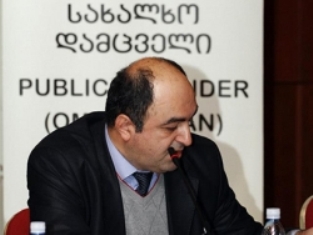
Public Defender expresses his deep condolences on the passing away of Gogita Abashidze on March 23, 2013 the infant living in the Region Khelvachauri. This sorrow is common for the entire society. Public Defender hopes that all concerned bodies will carry out an immediate and profound examination of the case, in order to establish whether it would be possible to avoid such a fatal development or not, if the relevant child care mechanisms were in place.
It is vital to analyze this case as a systemic problem, rather as an individual tragedy and to examine the adequacy of steps undertaken by the state.
In 2008, and later in 2009 and 2012 UNICEF published the analyses indicating that 12% of children in Georgia live in extreme poverty. Study implies that every child spends only 2 GEL per day, and 30% live in relative poverty. According to this research 10% of inquired families stated that the low level of food consumption threatened their health.
Destructive and irreversible effect of poverty on children has been reflected in annual and special reports of Public Defender of Georgia on numerous instances in previous years. Public Defender of Georgia addressed relevant state authorities to undertake effective measures in order to solve this problem.
In 2008 the UN Committee on Rights of the Child evaluated the situation in Georgia in the context of child poverty as disadvantageous. The committee expressed its concern on widespread poverty and distress in the country and stated that living conditions of many children are very poor, reflected in indicators such as accessibility to shelter, water and sanitation. Committee urged the member state to single out the chapter on children in the Strategy against Poverty and to prioritize their needs.
Current situation clarifies that recommendations of the UN Committee on Rights of the Child and Public Defender of Georgia as well as findings of international and regional studies have not been considered.
This tragic event clearly shows the need to reform existing social security system to foresee the needs of children as well as other vulnerable groups. Establishment of the state practice for preparing social policy based on evidence is essential. Such practice should be based on research and monitoring results and should primarily address needs, rather than resources. It should establish uninterrupted child care system, where every limb, in coordination with others, will provide adequate service throughout Georgia. Each public official should acknowledge his/her utmost responsibility stipulated by the law and should act toward any citizens’ request with maximum sensitiveness.
It is unfortunate, that an individual tragedy turns into bases for awakening in Georgia, as well as in many different countries. Developed and mobilized civil society for whom human rights violations of neighbor, co-villager or co-citizen are not insignificant and who responds to derogations immediately can prevent such harmful practices. As stated by Eleanor Roosevelt universal human rights begin in small schools, communities, farms and factories which cannot be seen on any map of the world. Unless these rights have meaning there, they have little meaning anywhere.
Public Defender expresses his hope that Gogita’s tremendously tragic history will be the turning point for the consolidation of the state as well as the society, for the establishment of practical attitudes toward the protection of human rights, in particular rights of the child where none of the citizens and over and above none of the state officials will close their eyes on existing violations and will act to resolve the problem with maximum sensitiveness.
News
October 30, 2024
PS Commission Members were hostile towards independent observers
Popular
Articles
November 15, 2024
Successfully Advcated Cases of the Union of Human Rights Defenders – Human Rights Center